Large language model (LLM) agents increasingly rely on persistent external sources to solve sequences of knowledge-intensive tasks. Existing methods improve how source content is accessed and organized, while agent-memory systems preserve reusable knowledge from prior interactions, but repeated use of the same source is still largely treated as repeated access rather than an opportunity to progressively improve understanding of that source. We study source learning: developing reusable source-specific competence over a persistent authoritative source. We represent this competence with a persistent source model that captures reusable understanding of the source, including how its knowledge is structured, interpreted, and applied. To construct and progressively refine such models, we propose SourceLearn, which combines two complementary learning mechanisms. Self-Directed Source Learning identifies what remains incompletely understood and adaptively revisits the source, while Task-Guided Source Learning uses downstream experience to reveal local representational gaps and recurring needs in how source knowledge should be organized. In both cases, learning signals determine what should be reconsidered, while persistent updates are reconstructed from the authoritative source. Across five benchmarks and three LLM backends, SourceLearn achieves the best performance in 13 of 15 settings, with gains of up to 22.6 points over Hybrid RAG and substantial overall improvements over static source representations and experience-based memory baselines.
Retrieval and agent memory make a source easier to access and past experience easier to reuse. When many tasks depend on the same source, the agent can do more: build source-specific competence, a reusable understanding of how the source's knowledge is structured, interpreted and applied, while the source itself stays authoritative.
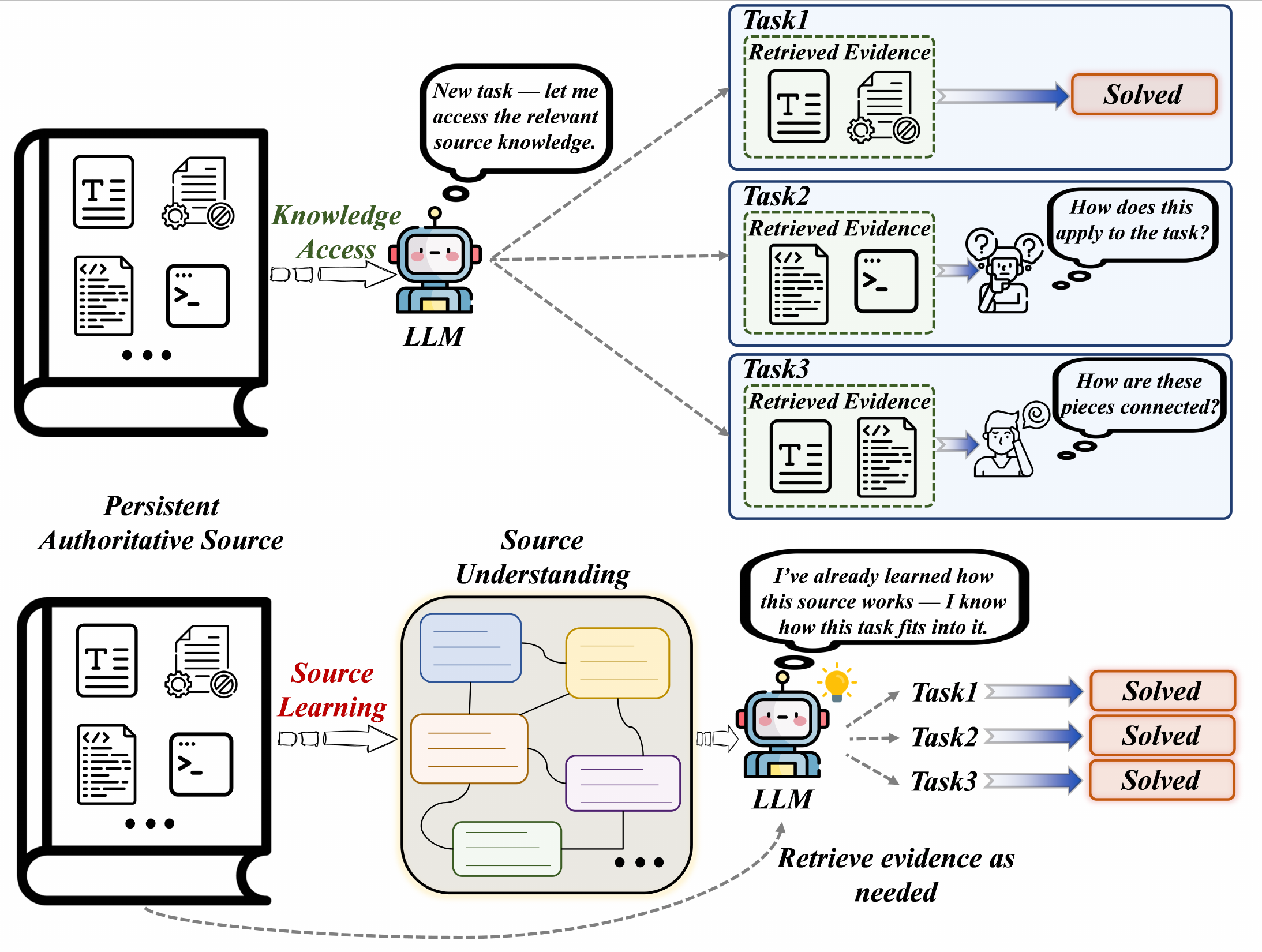
Knowledge access retrieves evidence per task and re-derives how to use it every time (left). Source learning accumulates reusable understanding across tasks while keeping direct access to the source (right).
What should be learned from a source before future tasks are known?
How can task feedback improve source competence beyond the task that produced it, without memorizing answers?
A persistent, revisable state M of what has been learned about the source, used next to retrieval: ŷ = F(q, R(D,q), M).
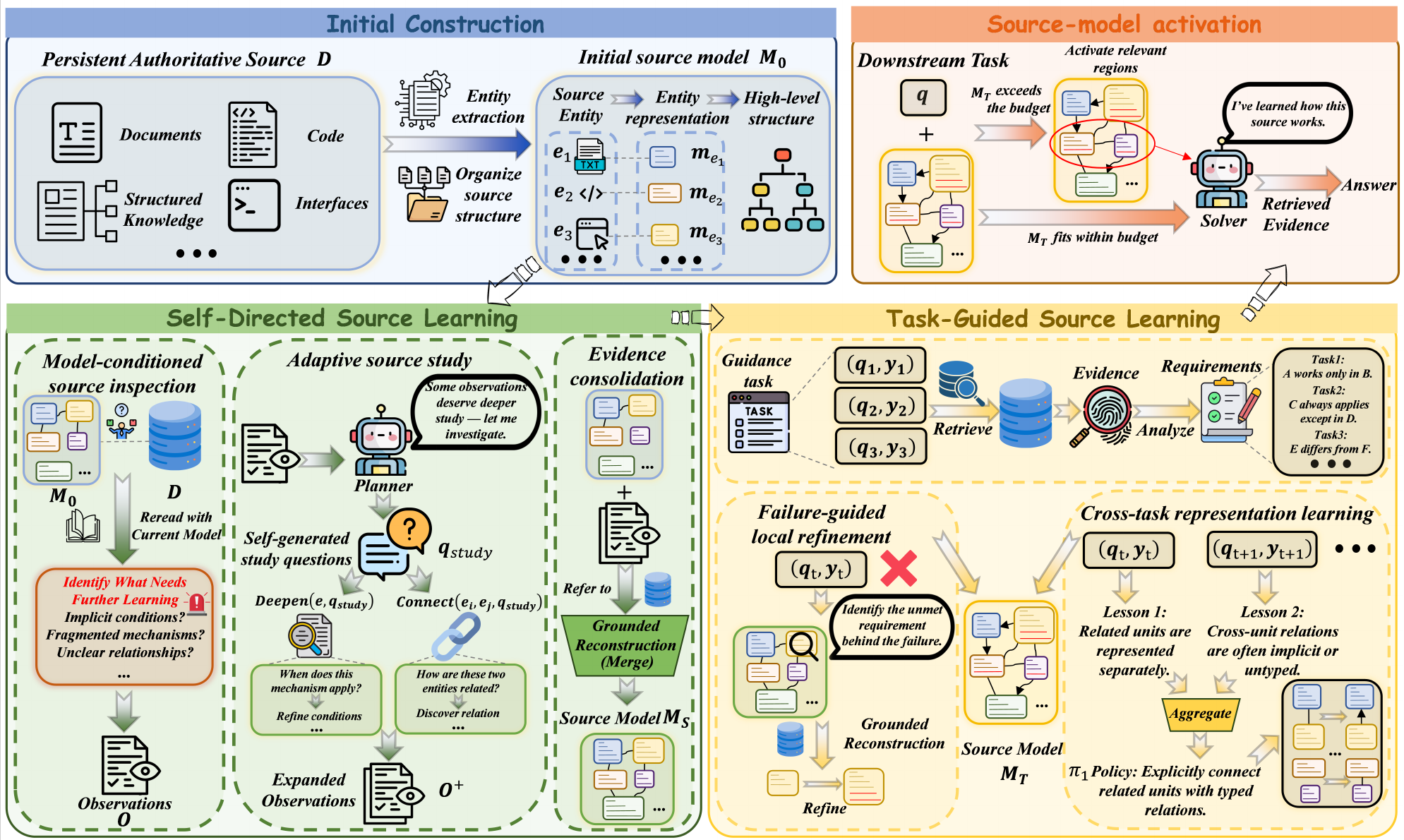
Three steps, one rule: learning signals decide what to reconsider; the source writes the update. Every persistent change is reconstructed from source evidence and must preserve previously supported meaning.
Overview. Construction builds M0; Self-Directed Source Learning deepens and connects it into MS; Task-Guided Source Learning refines it into MT; at task time the activated model is combined with retrieved evidence.
Entity-centered reading of the source yields a provisional model M0: entities, mechanisms, conditions, procedures, exceptions and relations. Look-up details stay in the source.
Inspect → Study → Consolidate. Reread the source against the model, plan Deepen / Connect study actions where it falls short, then consolidate into MS.
Guidance tasks expose gaps. Local refinement rereads the region a failure points to; cross-task lessons become a representation policy Π1 that recalibrates the whole model into MT. Answers are never stored.
Five benchmarks (document QA, code QA, tool use, interactive environments), three backbones, disjoint guidance and test tasks. SourceLearn receives the same retrieved evidence as Hybrid RAG plus its activated source model.
| Backbone | Method | Document QA | Code QA | Tool Use | Interactive Env. | |
|---|---|---|---|---|---|---|
| MultiDoc2Dial | NarrativeQA | SWE-QA | APIBench | AppWorld | ||
| GPT-5.6-Luna | Hybrid RAG | 64.9 | 66.0 | 56.9 | 47.8 | 72.0 |
| RAPTOR | 71.2+6.3 | 68.1+2.1 | 50.8−6.1 | 61.9+14.1 | 75.6+3.6 | |
| HippoRAG 2 | 66.3+1.4 | 66.6+0.6 | 62.7+5.8 | 55.2+7.4 | 77.4+5.4 | |
| AWM | 65.1+0.2 | 62.1−3.9 | 56.7−0.2 | 62.8+15.0 | 66.7−5.3 | |
| SourceLearn | 77.6+12.7 | 80.2+14.2 | 69.5+12.6 | 70.4+22.6 | 81.5+9.5 | |
| gpt-oss-120b | Hybrid RAG | 64.5 | 45.6 | 52.5 | 60.3 | 30.4 |
| RAPTOR | 61.5−3.0 | 40.4−5.2 | 32.8−19.7 | 54.7−5.6 | 26.8−3.6 | |
| HippoRAG 2 | 66.7+2.2 | 45.7+0.1 | 56.7+4.2 | 56.0−4.3 | 33.9+3.5 | |
| AWM | 64.1−0.4 | 43.2−2.4 | 51.5−1.0 | 63.2+2.9 | 28.6−1.8 | |
| SourceLearn | 68.7+4.2 | 56.7+11.1 | 53.4+0.9 | 71.8+11.5 | 27.4−3.0 | |
| DeepSeek-V4.1-Flash | Hybrid RAG | 63.3 | 64.2 | 45.9 | 67.1 | 83.9 |
| RAPTOR | 73.2+9.9 | 60.4−3.8 | 36.8−9.1 | 69.3+2.2 | 88.7+4.8 | |
| HippoRAG 2 | 67.3+4.0 | 62.0−2.2 | 55.7+9.8 | 69.6+2.5 | 86.9+3.0 | |
| AWM | 63.7+0.4 | 61.4−2.8 | 47.4+1.5 | 70.8+3.7 | 83.9+0.0 | |
| SourceLearn | 81.3+18.0 | 76.2+12.0 | 61.6+15.7 | 82.2+15.1 | 89.9+6.0 | |
Task performance (%); subscripts are changes relative to Hybrid RAG. Bold: best. Underlined: second-best.
What each mechanism contributes, what the source model comes to represent, and how it holds up when retrieval fails.
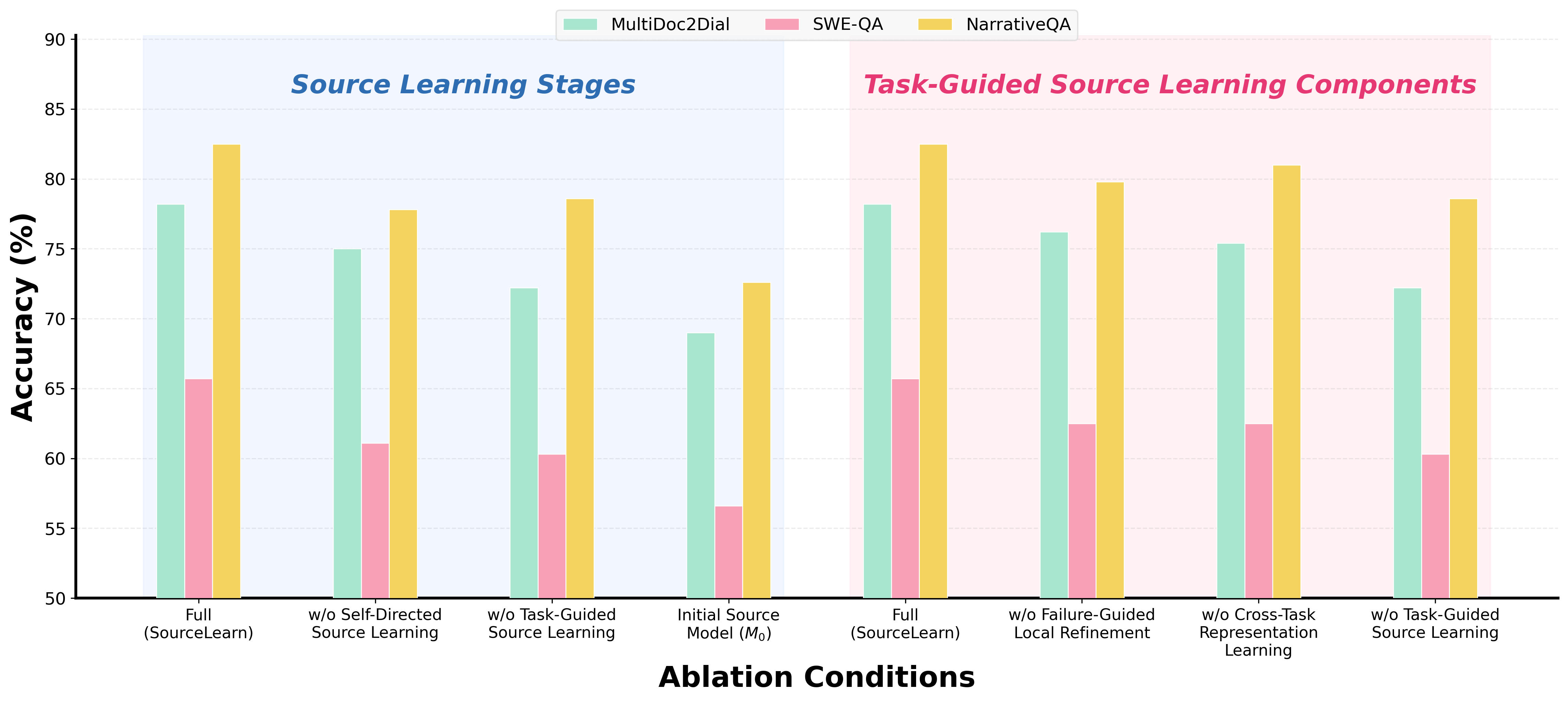
Ablation (GPT-5.6-Luna, two sources per QA benchmark): learning stages (left), Task-Guided pathways (right).
MT is best on every benchmark; dropping either Self-Directed or Task-Guided learning lowers accuracy, and M0 is lowest.
Failures repair local gaps; recurring lessons reshape the whole model. Removing either hurts, removing both hurts more.
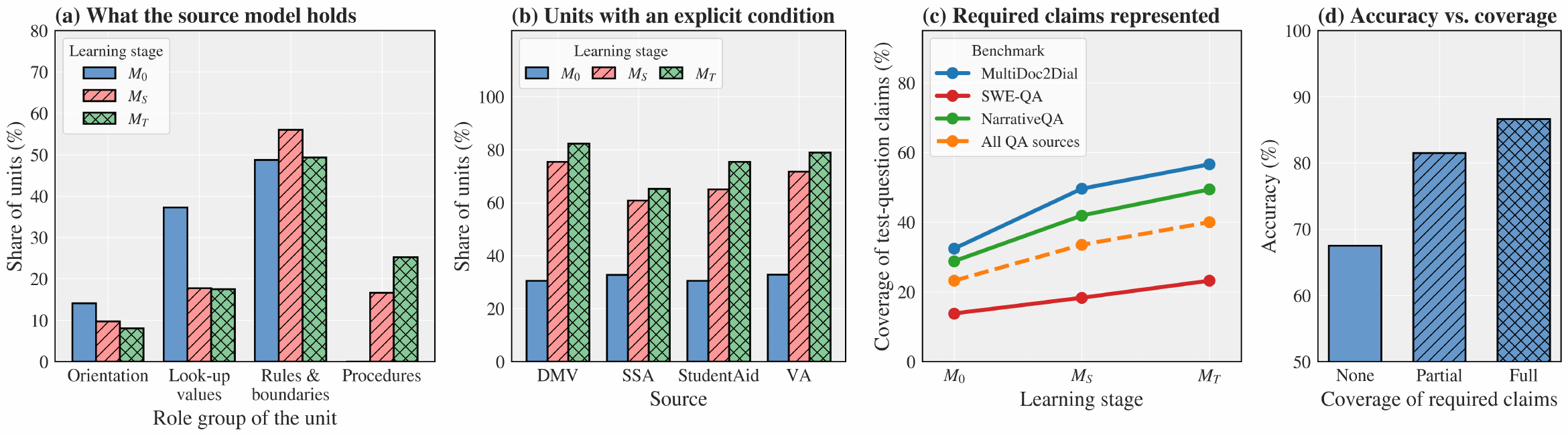
Learning shifts the model from look-up content to rules and procedures: conditioned units rise from ~30% to 65–82%, coverage of the claims test questions need rises from 23.2% to 40.0%, and accuracy goes from 67.5% with none of them covered to 86.6% with all of them covered.
From M0 to MS to MT: (a) what is represented, (b) explicit conditions, (c) coverage of required claims, (d) accuracy vs. coverage.
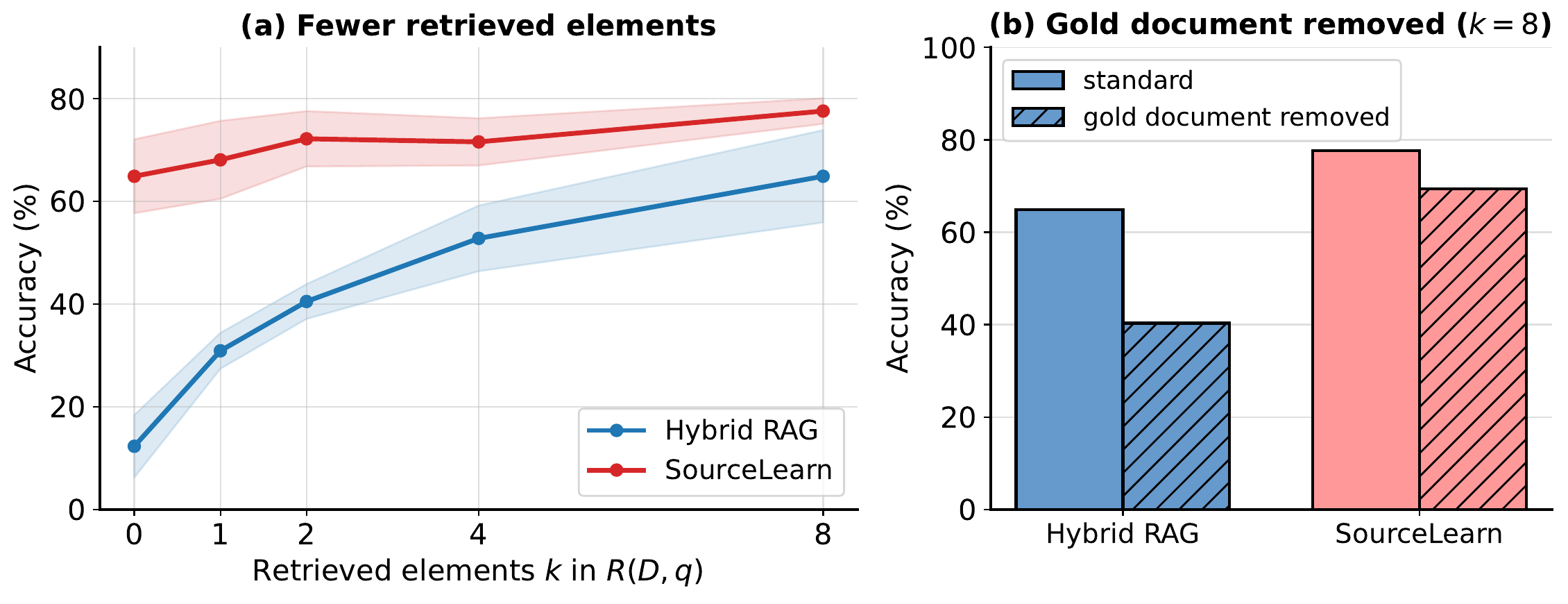
Robustness (MultiDoc2Dial, GPT-5.6-Luna): (a) fewer retrieved elements, (b) gold document removed at k = 8.
With no retrieval, the source model alone matches Hybrid RAG with 8 elements. Removing the gold document costs Hybrid RAG about 25 points, SourceLearn about 8.
+14.9 points over Hybrid RAG on regions touched by guidance tasks, +12.1 on regions no guidance task touched.
Contradictions with cited evidence stay ≤1%; 93–100% of claims dropped during rewriting remain represented.
@article{fu2026knowledge,
title={From Knowledge Access to Source Learning: Developing Source-Specific Competence},
author={Fu, Lucheng and Xia, Kejing and Wang, Yiyang and Jin, Yiqiao and He, Jinjin and Yang, Xiyuan and Liu, Haoxin and Yu, Ye and Jin, Haibo and Xiao, Yijia and others},
journal={arXiv preprint arXiv:2610.02150},
year={2026}
}